Choosing a brush set for travel sounds simple until you start packing.
Do you bring one round brush and hope it can do everything? Add a flat brush for buildings? A fine liner for details? A larger brush for washes?
Once you have a few different painting styles in mind, a small brush roll can fill up surprisingly fast.
For travel and plein air painting, the goal is not to bring the most brushes. It is to bring the right shapes for the marks you actually want to make.
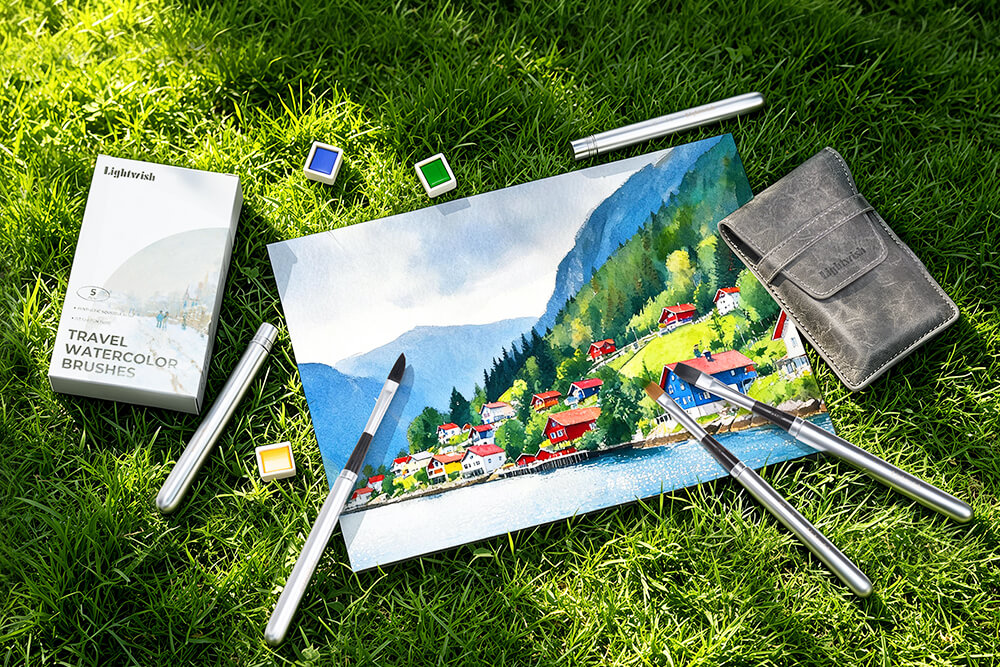
That idea is behind the LIGHTWISH 5-piece travel watercolor brush set. Instead of five versions of the same brush, the set combines five different shapes—Extended Point, Grain, Dagger, Flat, and Round—so you can move from broad washes to fine lines and textured details without carrying a full studio collection.
Here's what each brush is designed to do, and how to make the most of them on the road.
Why Brush Shape Matters More Than Brush Count
A travel brush can be compact and beautifully made, but that does not help much if every brush in the set behaves the same way.
Think about a street sketch. You might need a flat edge for a building, a pointed brush for window frames, and something softer for trees in the distance. A flower painting has a completely different set of needs. Leaves, stems, petals, and washes all call for different marks.
That is why brush shape matters.
A good travel brush set gives you more options without asking you to carry a dozen tools. You can pack fewer brushes while still having a way to handle different parts of the painting.
The LIGHTWISH set was designed around exactly that idea: five distinct shapes, each with a specific job.
The Five Brushes in the LIGHTWISH Set
1. Extended Point — For Long Lines and Fine Details
The Extended Point has a long, tapered tip that holds a fine point for detailed work.
It is especially useful for:
· Branches and stems
· Leaf veins
· Window frames and architectural details
· Fine outlines
· Signatures and finishing touches
One of the advantages of a longer point is that it can hold more water than a very short detail brush. That gives you more room to paint a continuous line before you need to reload.
For travel sketching, this is the brush you are likely to reach for when a painting needs a little more structure. 2. Grain — For Texture and Broken Marks
The Grain brush has a distinctive hair arrangement that creates a more broken, textured mark.
This makes it useful for things that are not supposed to look perfectly smooth:
· Foliage
· Grass
· Tree bark
· Rough surfaces
· Broken reflections on water
Instead of trying to paint every leaf individually, you can use the brush to suggest the texture of an entire area with a few strokes.
That makes the Grain brush particularly useful for landscape work, where a little irregularity can make a painting feel more natural.
3. Dagger — From Fine to Broad in a Single Stroke
The Dagger brush gets its name from its pointed, angled shape.
It is one of the more versatile shapes in the set because the same brush can create a narrow line, a wider stroke, or a gradual change between the two depending on how you hold it.
Try it for:
· Flower petals
· Leaves
· Ribbons and folds
· Curved structures
· Rooflines and angled edges
It is also useful when you want a brushstroke to feel deliberate rather than overly worked. One confident stroke can often do what several smaller strokes cannot.
4. Flat — For Clean Edges and Broad Areas
A Flat brush has an even, straight edge, which makes it particularly useful when you need structure.
It works well for:
· Walls
· Doors and windows
· Steps
· Waterlines
· Large flat areas
· Straight architectural edges
If you have ever tried to paint a straight building edge with a round brush, you already know why a Flat brush can be useful.
For urban sketching, this may quickly become one of the most practical brushes in the set.
5. Round — Your Everyday Watercolor Brush
The Round is the most familiar shape in the collection, and for good reason.
A full belly holds a good amount of water while the pointed tip gives you control when you need a finer mark.
Use it for:
· Skies and clouds
· Mountains
· Flowers
· Fruit and other rounded forms
· General washes
· Wet-on-wet painting
If you only brought one watercolor brush, a versatile Round would probably be the easiest place to start. In a five-piece set, though, it works better as the everyday brush while the other four handle more specialized marks.
What About the Brush Hair?
Natural squirrel hair is well known among watercolor painters for its ability to hold a lot of water. It is also soft and responsive, which makes it particularly useful for washes.
LIGHTWISH uses synthetic squirrel hair rather than natural animal hair.

The goal is to reproduce some of the useful characteristics watercolor painters look for in squirrel-style brushes: good water retention, a soft feel, and an even release of water and pigment.
In practice, that can be useful for several common painting situations:
Wet-on-wet: More water in the brush gives you time to work across a damp surface.
Glazing: An even release helps lay down a transparent layer without repeatedly disturbing the paper.
Texture work: A softer brush can sweep across the surface without feeling overly stiff.
Details: The pointed shapes in the set are designed to bring the stroke back down to a fine line when needed.
For artists who prefer to avoid animal hair, synthetic fibers are also a straightforward alternative.
Ferrule and Handle: The Details You Notice After You Paint With Them
The brush head gets most of the attention, but the parts around it matter too.
The LIGHTWISH set uses silver-plated brass ferrules to hold the bristles securely. A well-fitted ferrule helps keep the brush head stable during use and helps reduce the risk of loose hairs.
The handles use a mixed construction: silver-toned metal sections at both ends with a solid wood grip in the middle.
The result is a different feel from a lightweight plastic travel brush. There is enough weight to make the brush feel balanced in the hand without making the set feel bulky.
For longer painting sessions, that balance can make the brushes feel more comfortable to control.
A Travel Brush Set Should Be Easy to Carry, Too
A good set of brushes is only useful for travel if you actually want to take it with you.
The LIGHTWISH brushes come in a vintage textured leatherette storage pouch with an embossed LIGHTWISH logo.
Each brush has its place, so they can stay together instead of rolling around loose inside a backpack or pencil case.
That makes the set useful for:
· Outdoor sketching
· Travel journals
· Urban sketching
· Coffee-shop painting
· Weekend trips
· Plein air painting
It also gives the set a more finished feel when you are buying it as a gift. Before You Use a New Watercolor Brush
Before painting, take a few simple steps to prepare a new brush:
1. Uncap the Brush
Remove the cap to expose the bristles. Skip this step if the brush is already uncapped.
2. Remove Manufacturing Sizing
Gently rub the bristles between your fingers to soften any residual sizing glue left from manufacturing.
3. Spin the Brush
Hold the brush by the handle and rotate it gently to shake off any loose brush hairs.
4. Give It a Final Rinse
Thoroughly rinse the brush with warm water to wash away any remaining residue.
After rinsing, the brush is ready for watercolor painting. Avoid hot water, and handle the bristles gently to help maintain the shape of the brush tip.
Who Is This 5-Piece Travel Set For?
Beginners
The five shapes make it easier to learn what different brushes actually do.
Instead of buying several individual brushes and trying to figure them out one by one, beginners can experiment with five distinct stroke types in one set.
Watercolor Hobbyists
For someone who already paints regularly, the set is more about expanding what they can do without making their kit much larger.
Travel and Urban Sketch Artists
This is where the set really makes sense. The different brush shapes cover a wide range of marks while the storage pouch keeps everything together.
Artists Looking for a Gift
The combination of five brush shapes and a dedicated storage pouch makes the set feel more complete than a single brush, while still being practical enough for someone who paints regularly.
👉 [Shop LIGHTWISH Travel Watercolor Brushes]
Frequently Asked Questions
Can these brushes be used for gouache or ink?
Yes. The synthetic squirrel hair works with watercolor, gouache, and ink. Adjust the amount of water and pressure based on the medium and the effect you want.
Is synthetic squirrel hair the same as real squirrel hair?
No. Synthetic squirrel hair is a man-made fiber designed to offer some of the softness and water-holding qualities associated with natural squirrel hair, without using animal hair.
Which brush is best for beginners?
The Round is a familiar starting point for many beginners. As you explore different techniques, the Flat, Dagger, Extended Point, and Grain brushes offer more specialized marks and effects.
Are these brushes suitable for travel and plein air painting?
Yes. The five shapes cover a range of painting needs while keeping the set compact. The included storage pouch keeps the brushes organized and easy to carry.
How much does each brush weigh?
Each brush weighs approximately 17–20 g (0.6–0.7 oz), depending on the shape. The Dagger and Grain are around 17–18 g, while the Flat, Extended Point, and Round are around 20 g each.
Why does the screw connection feel a little tight or rough at first?
The new metal threads may feel slightly tight at first, especially with the plated surface. Simply screw and unscrew the connection a few times by hand to help it become smoother. Avoid forcing or overtightening it.
Why do the bristles look stiff when I first open the brush?
A small amount of manufacturing sizing helps keep the bristles in shape during production and shipping. Before first use, gently rub the bristles between your fingers, then rinse with warm water to remove the sizing and loosen the brush tip.
Will the brushes shed hairs?
You may notice a few loose fibers during the first rinse. Gently rinsing the brush before use can help remove them. Avoid pulling or bending the bristles unnecessarily.
Do I need all five brushes?
Not necessarily. You may use one or two favorites most often, but the five shapes give you more options for different subjects, marks, and techniques.
The Right Brush Set Is About Options, Not More Gear
Travel painting is easier when your tools stay simple.
You do not need to bring your entire studio with you. You just need enough range to handle the marks your painting actually requires.
That is what the LIGHTWISH 5-piece travel watercolor brush set is designed to do: five different shapes, synthetic squirrel-style hair, balanced handles, and a compact storage pouch in one portable set.
For a quick sketch, a weekend trip, or a full plein air painting session, the right brush can take up very little space while giving you a lot more freedom to paint.
👉 [Shop the LIGHTWISH Travel Watercolor Brush Set]